What would I say to her now?
I’m trying something new. You can listen to today’s letter (narrated by me) or you can read it below.
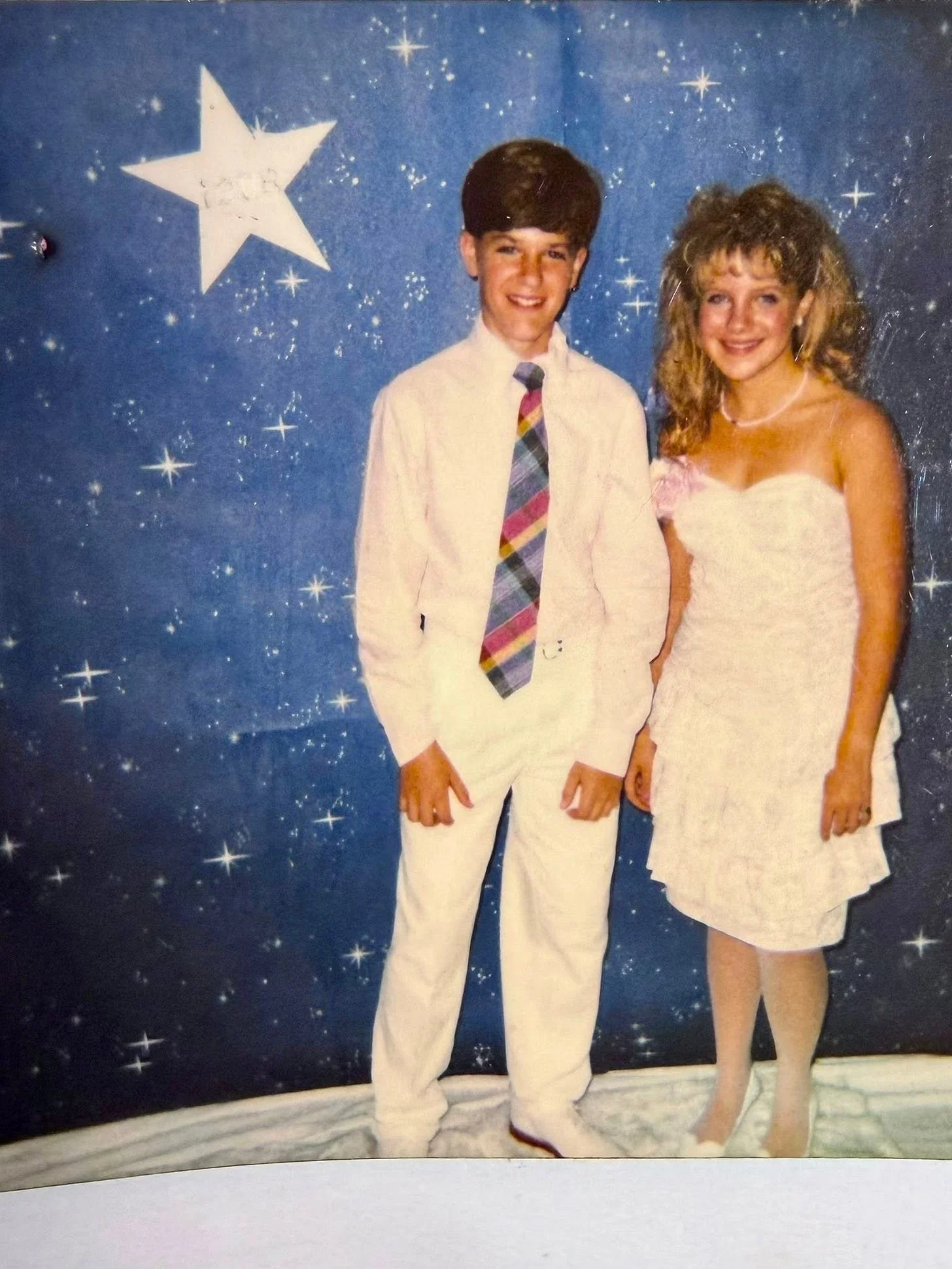
Recently, while organizing a cabinet, I came across a Polaroid picture from my 8th-grade dance back in 1988.
I coincidentally found this photo as my 14-year-old daughter was preparing for her 8th-grade dance, noting the glaringly obvious difference between the 80s big-hair era and the effortlessly natural style of Gen Z.
I know the younger generation spends hours on “skincare” and tending to their overall appearance, influenced by infinite access to beauty tutorials on TikTok. But all of that effort still results in a daughter that I recognize when she comes down the stairs each day, even as she continues to grow up.
On social media, I posted my 8th-grade dance pic alongside cute photos of my daughter and her friends and it prompted the obvious response: One of these things is not like the other.
One of my Gen-X friends summed it up well, “Amazing what happens when the current teen trend isn’t to make your hair huge, add weird gloves and some overly-extra pattern to all fabric/hose, and put on makeup with total disregard for what actually improves anything. Why did we (and our mothers) work so hard to look weird?!”
Why did we?
I know it was the style, and we were largely influenced by stars like Madonna and the cast of Knots Landing. When I was growing up, my mom was the spitting image of Donna Mills, in the best possible way.
But as I age, I’m so happy that I’ve developed a simpler style. I don’t feel like I’m trying so hard, and I certainly feel more comfortable in my own skin than I did back then.
Specifically: I’m no longer concerned that I’ll melt if I get caught in the rain.
But later, after having some fun with it, I started thinking about what I’d say to that girl wearing pantyhose to the school dance back in the 80s.
When I look at her eyes, beyond the eyeliner and eyeshadow, I remember how it felt to be her. I remember what was going on behind the scenes, how her sense of home and stability was coming undone.
As that girl transitioned from middle school to high school, the loss and longing intersected with a budding social life, cheerleading team and class president popularity, and her career aspirations.
I illustrate this storyline in my memoir Girl in the Spotlight, but to see a photo from that time at this stage in my life is really something. That girl wasn’t just a character in her own memoir. The girl was real.
The person I presented to the outside world wasn’t fake; she’s a part of me even today, but somewhere along the way, she kicked into overdrive. That worked for a while, until all of that pushed-down pain rose to the surface.
But if I could talk to that young girl now, I don’t think I’d offer her any grand advice. I’d simply ask her how she was doing. I’d wait patiently to see what came up, what she’d feel compelled to express and talk about.
I’d offer perspectives and reframes if given the opportunity, but most importantly, I’d direct her towards her own inner knowing. I’d tell her to be kind to herself, because learning to trust her heart is a muscle she’ll develop over time.
And, I’d resist the urge to tell her that one day, she’ll wonder why she felt compelled to tease her bangs to the sky. I’d probably just give her a hug instead.
What would you say to your younger self?